MTF Curves
Characteristic performance of optical systems can be evaluated in line-pairs per millimeter (lp/mm). So what is a line pair? It’s one black line, and one white line.
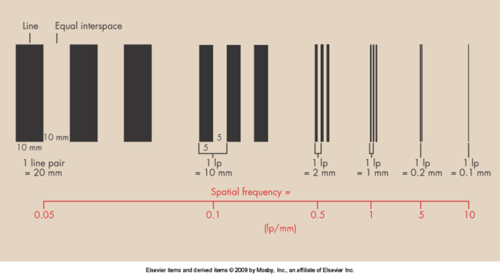
As shown in the figure above, the higher “spatial frequency” is 10 line-pairs per millimeter, while 0.05 line-pairs per millimeter is a much lower frequency. It could be described as coarse.
See below for a notional MTF curve example:
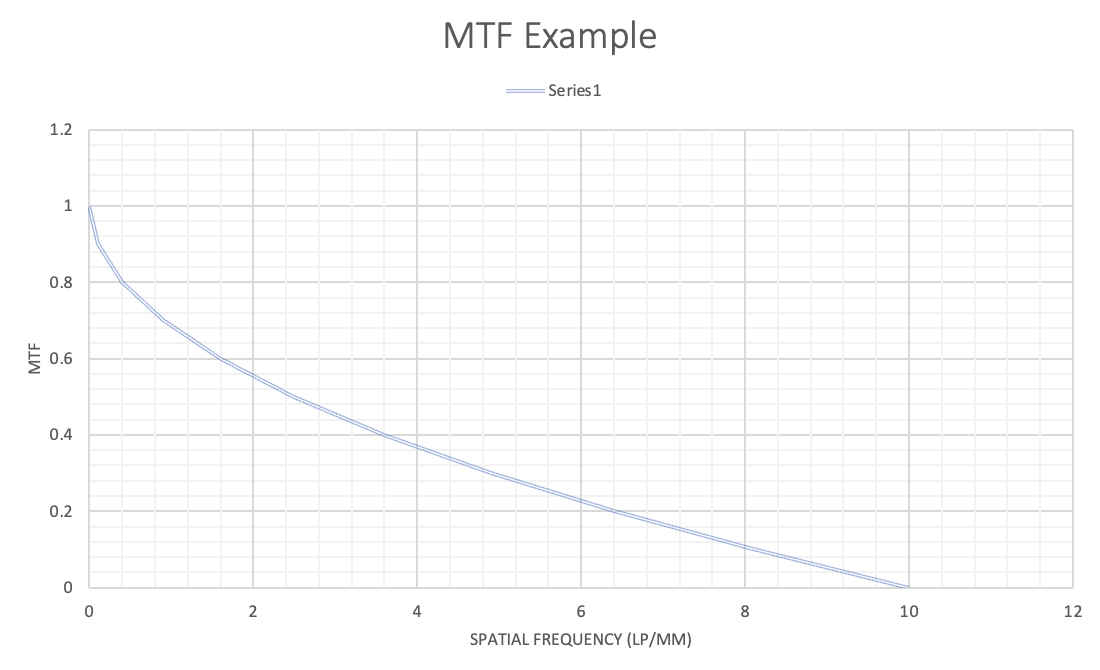
What does MTF stand for? Modular transfer function. Notably, the function’s value is equal to 1 to represent 1:1 perfect reproduction of line-pairs at a specific frequency. As the line-pair frequency increases, it can become harder for an optical system to reproduce the line pairs. The line pairs might get muddied together.
A muddied black-white line pair would look grey. This result creates a linkage that are often thought about separately: resolution, and contrast.
Standard usage of contrast and resolution:
Contrast = the difference in brightness or color in an image.
Resolution = resolved detail in an image that can be distinguished.
Based on these definitions, contrast and resolution don’t feel so inter-twined.
For example, consider an image that is grey or mostly white: a mountain goat on a snowy mountainside in soft daylight. A really nice camera could give a perfectly “sharp” image that would be low-contrast in our classic way of thinking. The overall range of brightness or color is a limited range.
This is where we want to separate the casual usage of these terms. In the above example, I would call that “macro contrast.” The overall image has a global maximum brightness and minimum darkness that is narrow. However, all variations in the shadows and highlights—from the white snow to the goat’s darker horns—will be generated from resolving all changes in brightness and colors across the image space. All the little transitions will be different scenarios of micro contrast.
Therefore, true MTF curves are not simply black and white line-pairs. There are MTF curves, theoretically, for every color in the image.
Imagine the edge of the goat’s fur against the snow. As your eye scans that transition between subject and background, you could describe this as a grey-white line pair. A high-MTF performing lens system would reproduce that grey-white line pair, with no loss to that line-pair’s micro contrast. Poor performance would muddy that transition, and you’d get a blurry grey-white blend at that transition point. Micro contrast at that point is reduced.
If the lens is a poor performer overall, every line-pair would have a muddy reproduction, and the macro contrast of the image would inevitably reduce. You lost the dynamic range of the full image, and the perceived resolution is now much lower too.
Last note — when do you see line-pairs? Film cameras escape this quirk in 2 aspects: an intake lens is a continuous (not discrete) optical system. So a poor lens in itself wouldn’t show obvious “lines,” but you’d surely perceive muddy images and deem resolution was lost. As well, film itself is an emulsion of many fine crystals suspected in random patterns. Overall, there are no line sensors in a film camera.
Where can you still get lines?
Digital camera sensors for those who shoot digital.
Scanners. As someone who currently uses flatbed scanners, this is an unfortunate drawback but necessary step in translating the analog film to digital.
