How many megapixels is film?
Megapixel, a unit of measurement, simply tells you the pixel count. 1 megapixel (MP) means one million pixels. This should literally translate to the total number of cells on a mosaic color array’s CMOS image sensor (CMOS = complementary metal oxide semiconductor):
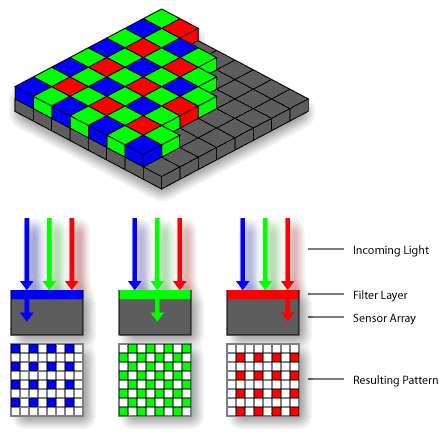
Literal sensor pixel count has gained common usage in daily language, because that value offers shorthand to indicate resolving quality of a digital sensor. The higher the megapixel count in a sensor, the greater amount of visual detail that can be recorded.
Lesser discussed is how this translates to display screens. We know a 50 MP camera would look great on a computer screen, but is that overkill?
Common resolutions of computer monitors and TV’s:
1920 x 1080 ~ 2,100,000 pixels, or 2.1 megapixels
2560 x 1440 ~ 3,700,000 pixels, or 3.7 megapixels
3840 x 2160 ~ 8,300,000 pixels, or 8.3 megapixels (4K)
A 1 MP camera, then, wouldn’t be able to display its image full-screen on any of these pixel grids perfectly without some translation. All these display sizes exceed 1 MP.
What’s more, comparing camera pixel counts to display screen pixel counts is not enough. Another factor to add in is the display size. Consider 2 common scenarios: (1) 5-in phone, and (2) 14-in monitor.
With real hardware we can assess, you can compute that hardware’s pixels-per-inch (ppi):
pixels-per-inch, ppi = {pixel diagonal count} / {screen diagonal length}
Let’s give those 2 examples of screens, knowing their diagonal’s, and the corresponding ppi:
Phone (6” diagonal) @ (3840 x 2160) = 734 ppi
Laptop (15.6” diagonal) @ (3840 x 2160) = 282 ppi
Is the phone more resolved than the laptop? Literally yes, by over 2.5x. But does that extra ppi matter on the phone? Our eyes are the final call. Thresholds for “good” can be defined by eye resolving power, which is a function of how far the user stands away from the screen:
ppi_ideal = 3438 / {viewing distance in inches}
**Explanation of the numerator: 3438 is specific to human eye angular resolution. The human eye can resolve detail as small as ~1 arcminute, or 1/60th of a degree. 3438, then, comes from the reciprocal of the tangent of 1-arcminute.
Using average viewing distances from our phone or laptop, we can compute thresholds for human eye ppi resolution.
Phone ppi threshold (~6–12" from eyes): ~300–500 ppi → “sharp” to the human eye
Laptop ppi threshold (~20–24" from eyes): ~150–200 ppi → “sharp” to the human eye
Based on these thresholds, a 4k phone and 4k laptop can appear similarly resolved, when viewed at the typical distance by the user, despite the laptop having half the ppi at 282 versus the phone’s 734 ppi.
In summary, we need more ppi on a phone for it to look as good. Bringing this back to the 1 MP photo, how do the screen ppi’s, and the eye ppi thresholds apply?
Let’s try to calculate the ppi for that photo on each device:
Phone ppi, 1 MP image = 236 ppi (21.3% below 300 ppi threshold for ideal phone viewing)
Laptop ppi, 1 MP image = 91 ppi (39.3% below 150 ppi threshold for ideal laptop viewing)
Note these values skip the upscaling that screens do to display the 1 MP image, according to their own pixel counts. While it does happen, let it be ignored for now. When all the math is said and done, percentages below ideal ppi for viewing proves something we intuitively think: that “low-res” 1 MP photo will look worse on a large laptop than on a phone.
Last, it’s common for photos on a phone or a laptop to not be full screen. If the image is only intended as a thumbnail or instagram picture, then a 1 MP photo could actually look just fine!
So, how many megapixels is a film camera?
Film has no perfect gridded mosaic sensor like digital. Film is a photosensitive material, with a gelatin suspension of silver halide crystals:
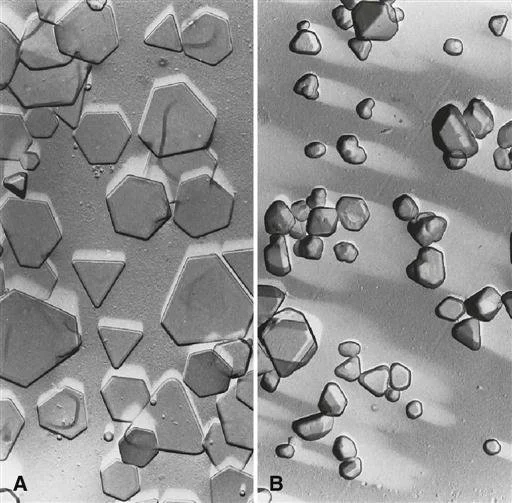
For fun, we could try to translate this kind of crystal emulsion to a pixel count equivalent.
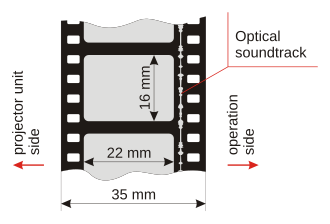
Without doing the math first, consider how many movies exist on film’s incredibly small negatives. Academy film is only 35mm:
Many of our favorite movies were shot, and are still being shot on film. This holds true despite common household consensus that “digital cameras are far superior to film.” In truth, film is an incredible tool with high-density visual data. Our ability to project, or scan that data, is where rubber meets the road for film’s full viewing potential. It’s important to remember that film has the ability to be incredibly resolved, and different workflows may limit our ability to see it.
It’s tempting to want to relate a film’s physical crystal size and density to a pixel count. This analogy could obscure resultant resolving performance of the crystals, however. Instead, we’ll start with known common resolving power of film that has been demonstrated in lab environment. It’s common rule of thumb that quality film resolves 100 line-pairs per millimeter natively on the negative itself. For more information on resolving power and line-pairs, see my post on MTF Curves.
Assuming 1 line-pair can be 2 pixels, then your film can resolve 200 pixels per millimeter.
Horizontal of 35 mm academy film is (22 mm x 200 pixels/mm) = 4400 pixels
Vertical of 35 mm film is (16 mm x 200 pixels/mm) = 3200 pixels
Pixel total count is 4400 x 3200 ~ 14.1 MP
Pixel “diagonal” is sqrt(4400^2 + 3200^2) = 5442 pixels
Film diagonal in inches is 1.07”
35 mm film ppi is 5542 pixels / 1.07 in = 5086 ppi
Alright, 14.1 MP at 5086 ppi natively on an un-enlarged film negative. Seems fairly good. When considering even larger negatives like 70mm and IMAX film, it makes sense how we maintain inclusion of film in cinema as a present-day tool.
An elephant in the room is that 14.1 MP can sound low in modern times. For example, the newest iPhone can take 48 MP photos. So why not just shoot movies on iPhones? Some claim you can, but further inquiry into individual pixel quality and literal light sensor space matter (to be continued).
