Understanding Acutance
When discussing MTF Curves, two terms were identified for describing an image: resolution, and contrast. When assessing overall image clarity, other terms become important.
Acutance in Photography
Acutance is also integral to understanding line-pair resolution. Acutance is how “sharp” an optical system can step up or down in a line-pair. Low acutance = smooth transition, while high acutance = sharp transition.
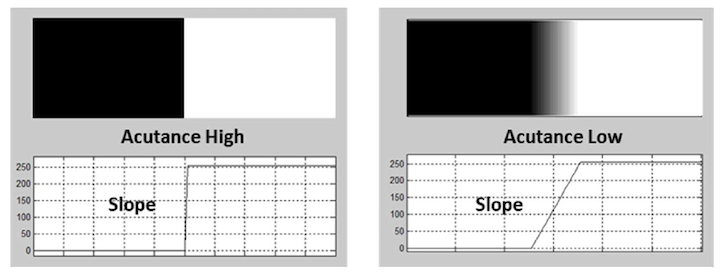
Notice how acutance is described as high or low, not good or bad. Naturally, many assume a high-acutance lens would be the best. But do we really want ultra-sharp images all the time?
To answer this question, first separate how acutance differs from resolution. Consider 2 lenses that offer the same, very high resolving power. One lens is high acutance, and one is low.
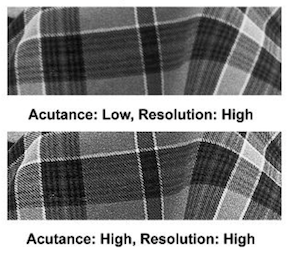
In both images above, my eyes tell me the blanket is well-resolved. However, it’s very clear the top image looks softer and less textured. To be honest, it even appears the smoothing effect of the low-acutance image begins to obscure the alternating black/white fibers on the stitching. Despite this, keep in mind the image isn’t aliased in total data. Both images contain equal mounts of visual datapoints. There is no difference in sampling rate, so under-sampling or aliasing is not explicitly occurring in the top photo.
However, low acutance is causing a visual blur in the stitching, giving a soft grey look on the stitches that are otherwise alternating black and white. Any further decrease in acutance, and perhaps we’d feel a significant loss in clarity. The blanket would continue becoming a muddy-grey blur, and then further performance characteristics would suffer: we’d start concluding a loss in contrast, and indistinct line-pair resolution.
In this way, we conclude egregious decrease in acutance can affect resolution and contrast. While all these terms are descriptive in their own right, they affect each other.
And yet, acutance is not something to max out at all times. Depending on the photographer’s desired look, low acutance could be desirable. I’m coming to love the soft look more and more, especially in portraiture.
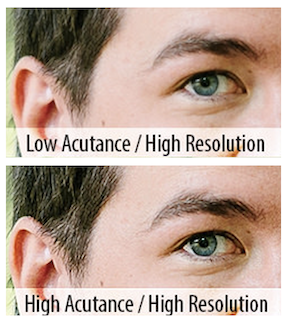
Everyone likes the idea of a sharp photo until it shows their pores. Truly, a soft portrait from a world-class lens can give a dreamy look. Overall, I keep acuteness high when texture adds intrigue, grit or I want to demonstrate the full optical potential of a lens, e.g. architectural compositions.
Finishing thoughts on another word thrown around: sharpness.
When can I say a photo is sharp?
Sharpness is far more a perceived quality than these stricter definitions of resolution, contrast and acutance. You can say it whenever you want, but its usually because you perceived high resolution and acutance.
Of note, there is an easy trick used in photography that utilizes acutance. First, assume you have a low-resolution image of a person, and you want to make it look higher in clarity. To fix this, you slide the “sharpness” scale to the right on your phone. This applies some flavor of acutance-enhancing over the entire visual image space. Likely, the person probably looks a little weird now—pores look dark, wrinkles pronounced, and maybe the photo looks a little unsettling overall. So what do you do instead?
A common post-processing “bake” in digital images, then, is scanning the image for macro object boundaries—like the silhouette of the subject’s body, the subjects’ eyes, and so on. The boundaries are identified and a feathered acutance process is applied to offer more definition. With macro visual cues now sharpened in the photo, your eyes have subtle cues that make the image clarity feel higher.
Citations
Rosa, Fabrizio La, M.C. Virzi, Filippo Bonaccorso and Marco Branciforte. “Optical Image Stabilization ( OIS ).” (2015).
